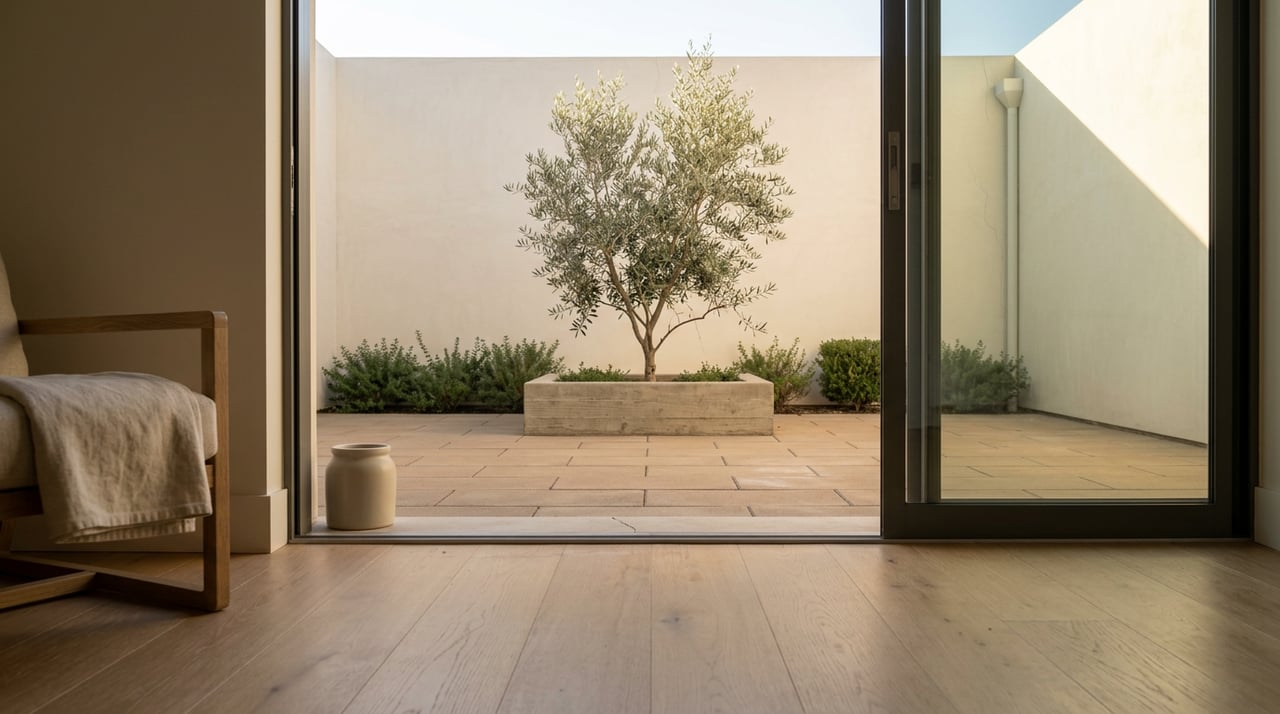
What You're Really Buying on the Newport Beach Waterfront
Open any portal and Newport Beach reads like one market. The Zillow Home Value Index landed at $3,687,121 as of late May 2026, up about 9.8% year over year. Movoto put the July 2026 median list at $3.69M and $1,323 per square foot. Redfin, working from a different sample and window, showed a three-month median closer to $3.4M. Three numbers, one city, and none of them tell you the thing that actually separates a $4M inland home from a $4M home on the bay.
The thing they leave out is the second price. On much of Newport Beach's waterfront, the sale price buys the structure. The land under it, the water in front of it, or both, come with a lease attached — and that lease has its own rent, its own escalator, and, right now, its own appraisal cycle at the state level.
A fee-simple parcel along the coast often ends at the mean high tide line rather than the water's edge at low tide. Everything beyond that line is a different transaction.
A useful way to read Newport Beach waterfront listings is to separate the purchase price from the recurring ground or water rent. The recurring number is where the market's real friction lives. It shows up as monthly land rent in some enclaves, as an annual pier permit fee in others, and as a mooring license somewhere out on the water. Financing treats each of them differently. So does resale.
Three structures cover most of what a buyer will encounter:
| Structure | Where you see it | How rent is set |
|---|---|---|
| City land lease (tidelands trust) | Beacon Bay | 2.5% of purchase price per year, plus annual CPI, on a 50-year term |
| Private ground lease | Lido Peninsula | Monthly space rent set by the private landowner; renewals per lease |
| Tidelands pier or mooring permit | Balboa Island, Lido Isle, Linda Isle, Harbor Island, Bayshores, waterfront peninsula lots | Per-square-foot or per-linear-foot rate set by the City acting for the State |
Every one of these is a rent, not a fee. That distinction matters more than it sounds, because rents get reappraised.
Beacon Bay is the cleanest example of the second-price mechanism because it is spelled out on the face of every deal. The community sits on tidelands the State granted the City to manage under the Beacon Bay Bill of 1978. Buyers do not acquire the dirt. They sign a 50-year lease with the City of Newport Beach and pay annual ground rent calculated at 2.5% of the purchase price, with annual CPI adjustments layered on top.
Run the arithmetic on a hypothetical $6M Beacon Bay purchase. Ground rent starts around $150,000 per year, or $12,500 per month, before CPI. Layer property tax at roughly 1.3% on the improvements and total annual carry lands somewhere near 3.8% to 4% of the price. That is a very different holding cost than a fee-simple home on Lido Isle at the same sticker.
Two mechanics deserve attention. First, the 2.5% is anchored to the purchase price, which is why listings occasionally advertise homes sold mid-construction as a lease-basis saving. Once construction completes, the lease rent does not automatically reprice to the finished value. Second, CPI adjustments compound. A 3% inflation year compounded over a decade quietly reshapes the annual carry by roughly a third.
For lenders, this is a leasehold loan. Underwriters look for a remaining lease term that exceeds the loan term and for lender protections written into the lease itself. A 50-year lease reset at each sale keeps the community financeable. It also means the escrow paperwork runs longer than a standard fee transaction.
Lido Peninsula behaves like Beacon Bay in structure and unlike it in economics. Homes sit on land owned by a private lessor rather than the City, and the recurring number is a monthly space rent rather than a percentage of price. Recent listings have advertised monthly land rent figures in the $2,600 to $3,900 range depending on the site and lease vintage.
The reason list prices in Lido Peninsula can look inexpensive against the rest of Newport Beach is exactly this. A $1.275M asking price with a $3,917 monthly ground lease is not the same asset as a $1.275M fee-simple condo elsewhere in the city, and it is not underwritten the same way. Conventional financing can be available, but the pool of lenders is narrower and the remaining lease term drives everything. Buyers who plan a long hold need to read the renewal language before they read the floor plan.
Waterfront ownership in Newport Harbor stops at the bulkhead or the mean high tide line. The seabed under the dock, the slip, and the mooring field is tidelands, held in public trust and administered by the City on behalf of the State under the Beacon Bay Bill of 1978. That means a private pier at a Balboa Island or Linda Isle home operates under a City-issued permit, and the permit carries a rent.
Two things about that rent are moving right now, and they are the reason this section leads with the friction rather than the amenity.
Residential pier permits in Newport Beach have been charged at $0.58 per square foot. In August 2025, staff at the California State Lands Commission presented a draft report finding that fair rental value "may actually be as much as double that current rate," and characterizing the City's pattern of reducing lease areas and rates without fresh appraisals as decisions that "appear to be political in nature." The City has since begun an updated appraisal. There is no final number yet.
The mooring side of the same harbor is further along. The current offshore mooring rate sits at $3.34 per linear foot per month, or roughly $133 for a 40-foot mooring. A City proposal would move that to about $15 per linear foot, or roughly $600 per month for the same 40-foot boat, and would phase out private transferability by converting mooring permits to month-to-month licenses managed by the City. That last point is the one the market has not fully digested. A mooring permit that historically traded privately becomes a City-controlled license without an aftermarket.
If you are buying a home whose value assumes a boat lives out front, you are buying an asset whose carrying cost is under active repricing.
Local weekly reporting through mid-July 2026 put the Newport Beach and Corona del Mar six-month closed median for single family homes at $4,612,350, at a median of $1,650 per square foot, with a median of 19 days on market once a home priced in line with comps. The active-listing median sat closer to $2,034 per square foot, a spread of roughly $384 per foot between what sellers are asking and what closings support.
That spread is not evenly distributed. It concentrates in the exact tier where lease exposure lives. A waterfront home carries a price for the structure plus an embedded expectation that a dock or mooring conveys with usable, permanent, market-priced access. When that expectation is repricing at the State level, aspirational asking prices sit longer. Homes priced against closed comps that reflect the real carry are still going in about 19 days.
Read the spread this way and the market is not slow. It is discriminating.
For a waterfront offer in Newport Beach, the standard inspection checklist is the beginning, not the end. Ask escrow for:
The order matters. Financing feasibility should be answered before the appraisal contingency runs, not after.
Do land-lease homes appreciate like fee-simple homes? They can, but the lease term drives the curve. Value tends to compress as the remaining term shortens, which is why communities like Beacon Bay use lease resets at sale to keep terms long. A short remaining term without a defined renewal is the risk case.
Can I finance a Newport Beach home with a leased pier? Yes for the home itself. The pier permit is a separate instrument, and lenders will want to see it, its rent, and its transfer provisions. Larger dock rent increases can affect debt-to-income calculations at underwriting.
Will the State take over harbor rate-setting? The City has been operating under a warning that the State can intervene if it does not discharge its tidelands trust duties, and the 2025 State Lands Commission action escalated that pressure specifically on residential pier rates. The practical reading is that residential pier rents are more likely to rise than fall in the next appraisal cycle.
Buying on the water in Newport Beach is not the same transaction as buying a block inland, and the difference is not really about view. It is about which prices are fixed at close and which ones keep moving after you have the keys. If you want a read on a specific address before you write the offer, David Espino is happy to walk the lease structure, the permit file, and the comps with you. Let's Connect.
Stay up to date on the latest real estate trends.

Working with David Espino means partnering with a proven Orange County expert known for delivering exceptional results in the luxury market. With nearly a decade of experience and over $110M in sales, he combines strategic pricing, high-impact marketing, and skilled negotiation to help clients move forward with confidence.
DAVID ESPINO | CA DRE# 02014458
COLDWELL BANKER REALTY | CA DRE# 00616212
[email protected]
(949) 547-5181
ADDRESS 840 Newport Center Dr Ste 100 Newport Beach, CA 92660